01
You're a producer.
The cost of REP falls on you. To do reuse and qualify for the bonuses, you have to get those containers back from your customers, and prove how many times each one has been used.
7.5Mt
of professional packaging placed on the market per year in France.
ADEME
17Mt
within scope of the upcoming REP pro scheme (France's extended producer responsibility scheme for professional packaging).
Citeo Pro
128M
pallets sold per year in France.
EPAL France
$7.3bn
market for IBCs in Western Europe.
Future Market Insights
01
The cost of REP falls on you. To do reuse and qualify for the bonuses, you have to get those containers back from your customers, and prove how many times each one has been used.
02
You stay responsible for them until their end of life is proven. You resell the empties without getting a fair price, for lack of visibility into their value.
03
You put packaging back on the market with no objective way to grade what you collect. Removing tape, glue and labels takes forever. Your invoices get disputed from both sides.
All three roles finally share the same data. More transparency, more performance.
Centralized data
so everyone can turn reuse into an opportunity.
Reuse proven, compliance generated.
Proof of reuse kept for ten years in Europe: AGECREP proPPWR
The value of the used container made objective, pickup in one click, liability lifted once end of life is proven.
Condition graded on receipt, objective invoicing.
Tailored flows: together we define your containers' journey, to optimize their traceability with as few scan points as possible.
01
A unique QR code per container, enriched when it is created.
02
Several QR codes grouped by pallet, big bag or order.
03
The scan updates the container's status.
04
Visual inspection of the container, categorization of issues.
05
Refurbishment steps suggested based on the grading.
06
Real-time stock, by status.
07
Know and manage your fleet's wear.
08
Container deactivation, dispatch and receipt for recycling logged.
1 / 8
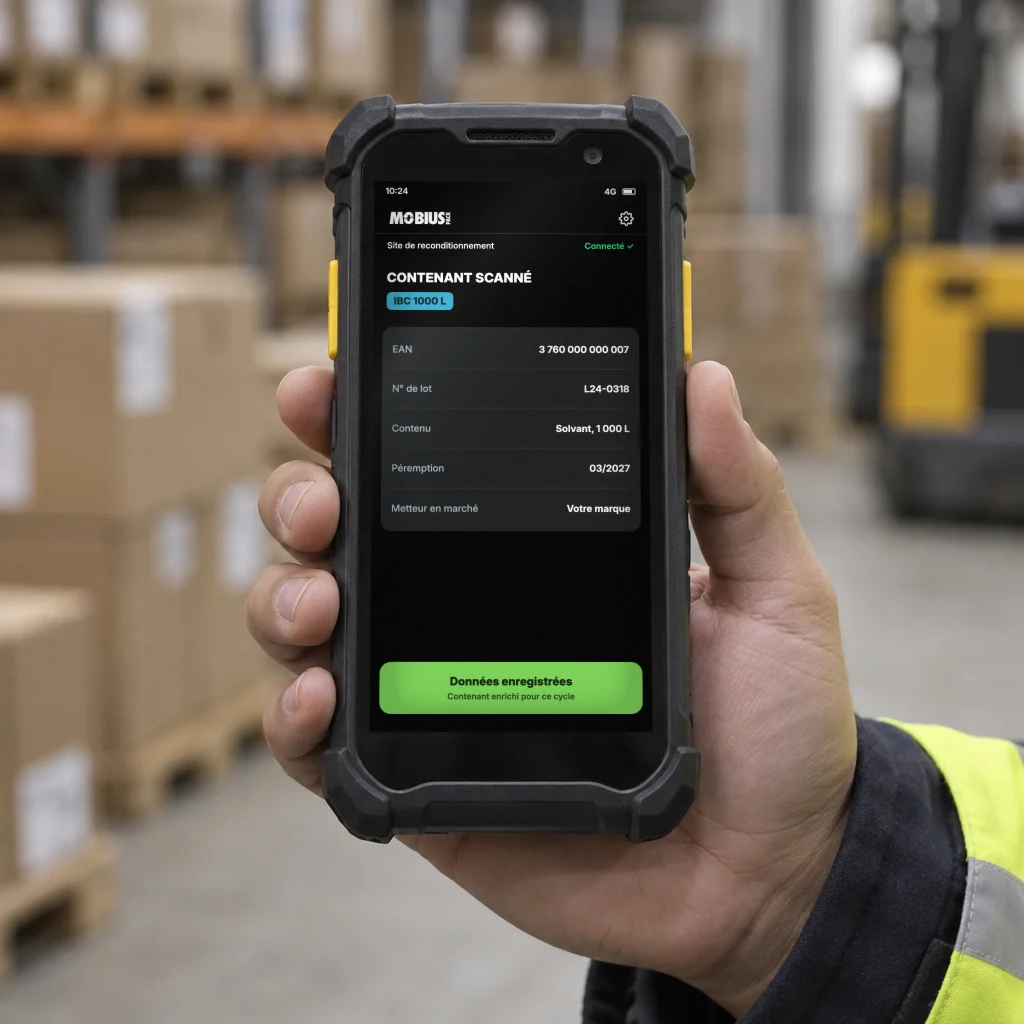
Data recorded for this cycle
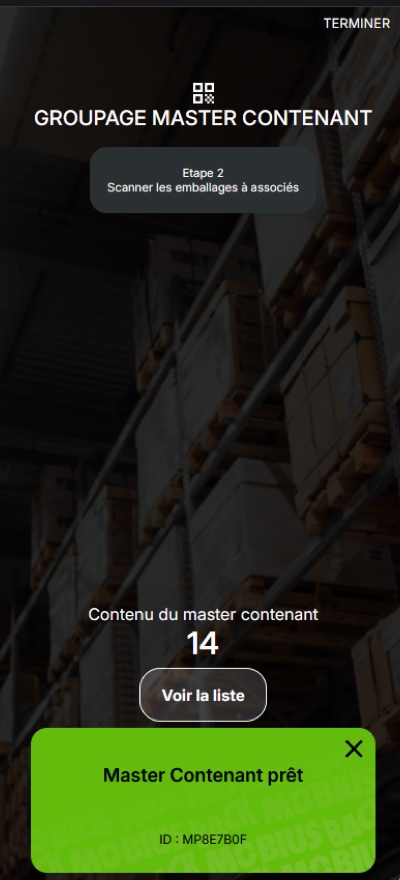
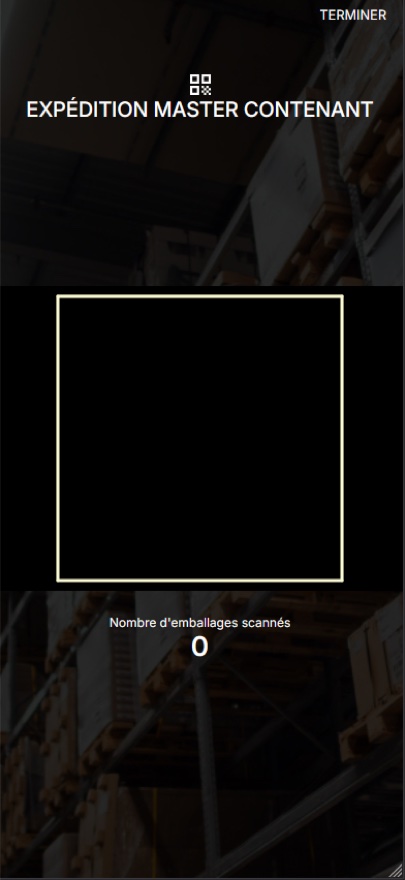
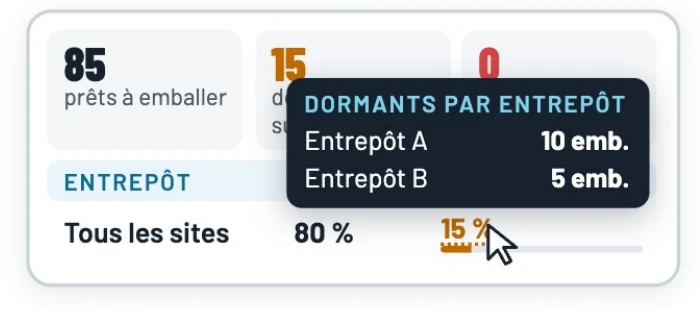
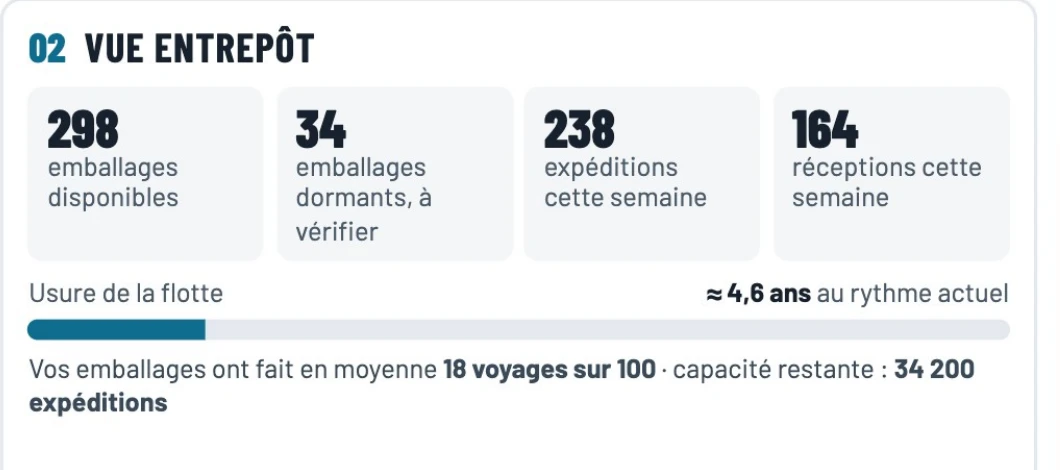
Everyone sees what concerns them: network, site, reconditioner.
Visual and audio signal, duplicates and invalid codes caught.
Missed steps are reconstructed automatically.
The journey of every container, and your data ready to export.
Your reuse compared with your disposable packaging consumption.
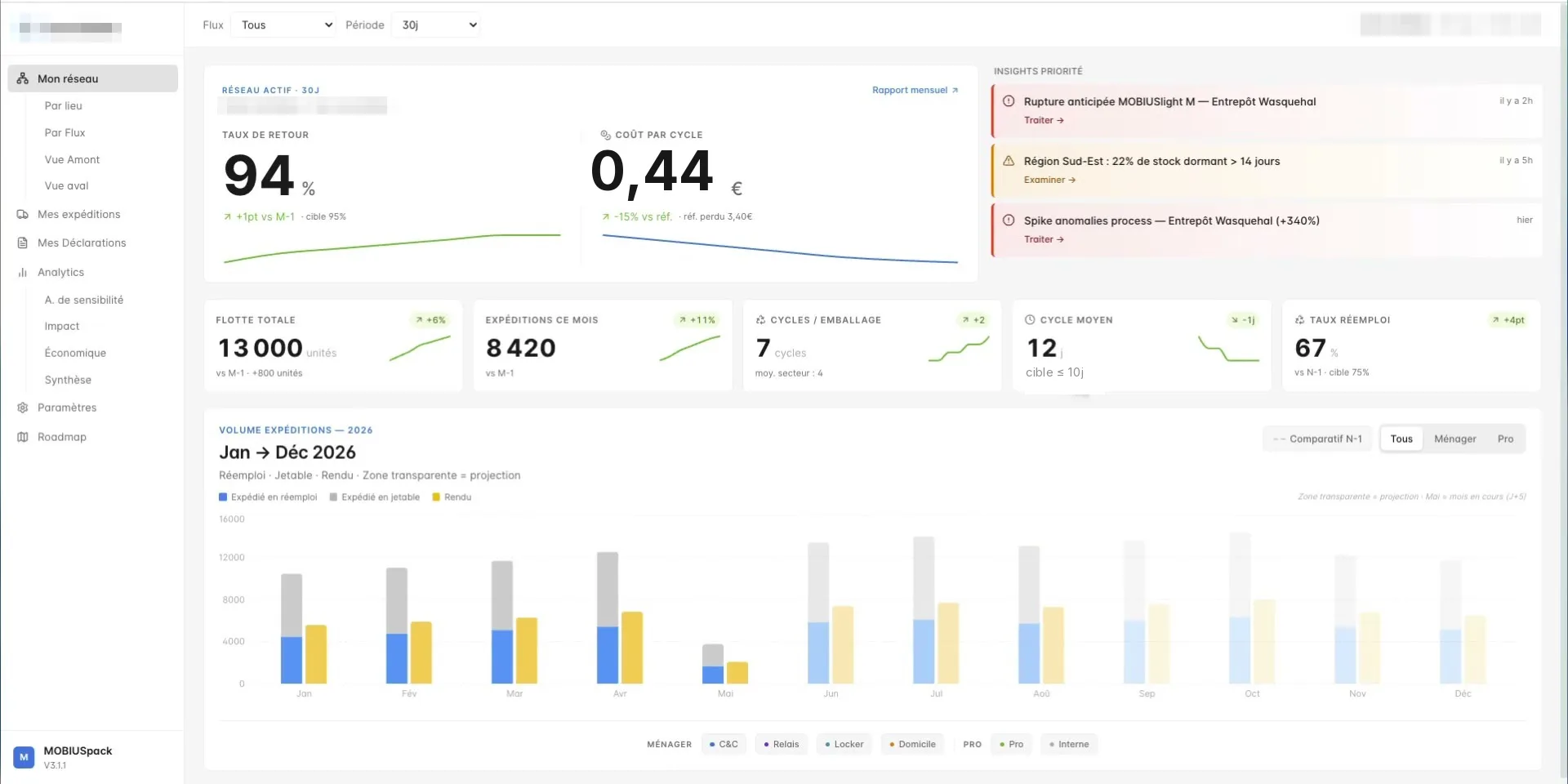
Not just another dashboard: the tool that tracks every container, communicates at the right time with whoever holds it and manages your project, on both financial and non-financial terms.
The scanning app, on a rugged Zebra terminal in the warehouse or on iPhone: every container identified, every movement logged.
Profitable collection doesn't chase empty containers around. It knows in advance where they are and groups them.
01
Plan ahead
The data flags empty containers and dormant stock at your customers' sites: pickup gets planned instead of just happening to you.
02
Consolidate
One single route per zone, containers grouped into batches: the cost per container collected goes down.
03
Route smartly
Each batch goes straight to the nearest or most relevant reconditioner, with no detour through a central site.
Condition graded on receipt, and every cycle documented all the way back to the producer.
01
All of it: yours as well as ours, from shipping packaging to IBCs.
02
Yes. The platform tracks your containers as well as ours, with no need to change packaging.
03
Yes, for reusable pallets and pallet wraps.
04
RFID, BLE or QR code, depending on your flows.
05
No. We often start with a QR code; RFID or BLE make sense depending on your volumes and flows.
06
Every link, producer, washer, carrier or recipient, scans with its own profile. Everyone shares the same data on the container's condition and location.
07
Via API with your WMS, ERP or TMS, with no extra development.
08
Every cycle is logged individually and your filings are generated from that data. Proof of reuse is stored in Europe for ten years, the period set by law (AGEC, REP pro, PPWR).
09
We organize collection by planning ahead and consolidating routes.
10
In France, it applies from 1 January 2027: producers of professional packaging join an eco-organization and pay an eco-contribution, at least 5 % of which goes toward reuse.
In Europe, the packaging regulation (PPWR, EU 2025/40) extends extended producer responsibility to all packaging, professional packaging included. Above all, it sets reuse targets for transport packaging starting 1 January 2030: at least 40 % reusable pallets, crates, IBCs, drums, jerry cans or pallet wraps for each operator, and 100 % for flows between your own sites or to another operator in the same country (excluding pallet film and straps). Cardboard boxes are exempt.
These rates are calculated per operator and per calendar year: you'll need to be able to count every unit of packaging and every rotation.
1 / 10
30 minutes to review your flows and estimate what traceability and collection can recover: losses, rotations, compliance.